
Beginner Guide
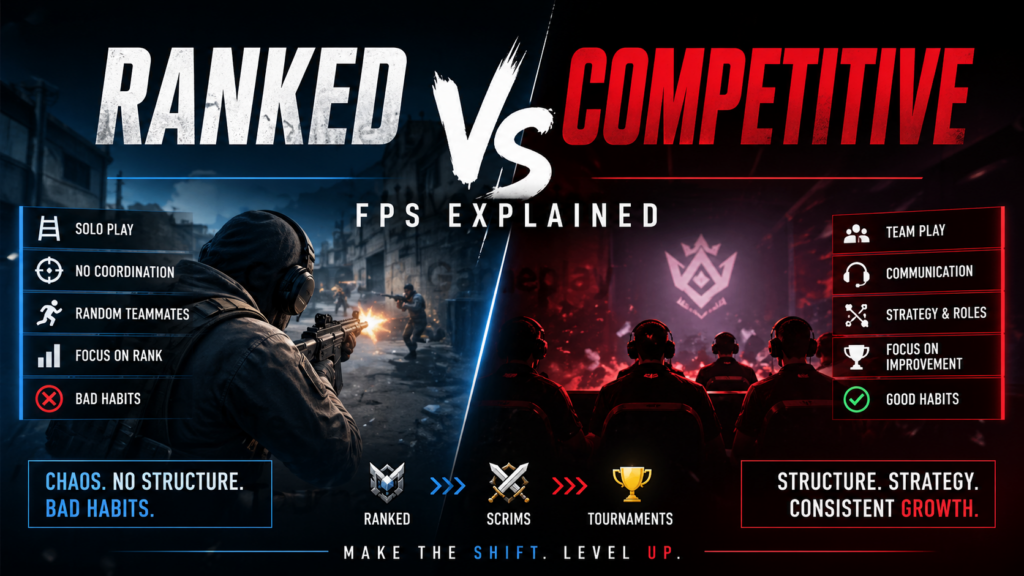
The ranked vs competitive FPS difference is bigger than most new players expect. Ranked can make you sharper, faster, and more confident, but competitive play asks a different question: can you perform inside a team system when roles, timing, comms, rules, and review all matter?
Ranked and Competitive FPS Are Not the Same System
Ranked play is built for matchmaking. It gives players a queue, a rank, a public measure of progress, and a way to test themselves against a wide mix of teammates and opponents. It is useful because it creates pressure, repetition, and a reason to improve. For many players, ranked is the first place where aim, movement, reactions, positioning, and confidence start to become serious.
Competitive FPS is built around structure. Instead of dropping into a lobby with whoever matchmaking gives you, players enter organized scrims, team practice, leagues, ladders, or tournaments with expectations already attached. There may be defined rosters, agreed rules, scheduled times, map or mode preparation, communication standards, and review after matches.
Ranked vs Competitive FPS at a Glance
The easiest way to understand the gap is to compare what each environment rewards. A ranked match can be won by one player catching fire. A competitive match usually exposes whether five players understand space, timing, trades, rotations, roles, and pressure together.
Why Ranked Builds Bad Habits
Ranked is not bad. The problem is that ranked rewards certain habits that can break down in structured play. In matchmaking, players often learn to solve problems alone because they cannot rely on strangers to play a system. That can create confidence, but it can also create impatience.
Competitive teams notice habits that ranked often hides. Over-peeking becomes a missed trade. Chasing kills becomes a lost objective. Loud comms become clutter. Playing for stats becomes a weak team round. Ignoring a role becomes a broken setup.
Solo-carry thinking
Ranked can teach players to force every fight. Competitive FPS asks whether the fight helps the round, the objective, and the team setup.
Scoreboard chasing
A player can top frag while still ignoring timing, trades, utility, rotations, or objective pressure that the team needed.
Loose communication
Long complaints, vague callouts, and emotional reactions may pass in ranked. Scrims need information that helps the next decision.
No review habit
Ranked encourages instant requeue. Competitive gaming improves when teams stop, review patterns, and turn mistakes into practice goals.
What Competitive FPS Systems Actually Include
Competitive FPS is not just harder ranked. It is a different operating model. Teams and organizers use systems to reduce confusion before the match even starts. Those systems create the conditions for better practice, cleaner tournaments, and fairer expectations.
Defined rosters. Players know who is starting, who is substituting, what roles exist, and who makes decisions during practice or tournament play.
Scheduled scrims. Practice happens in blocks with times, opponents, rules, regions, and goals instead of random queue sessions.
Role discipline. Players understand why they are anchoring, entering, supporting, calling, holding space, rotating, or playing objective pressure.
Review and adjustment. Teams identify patterns, set practice goals, change setups, and improve between scrim blocks instead of repeating the same mistakes.
How Scrims Change the Way You Play
Scrims are where many ranked players first feel the difference. A scrim can look like a normal match from the outside, but the purpose is different. Teams are practicing coordinated habits. That means the result matters, but the learning matters too.
In structured scrims, you may be asked to repeat a setup, hold a position longer than feels comfortable, delay instead of ego-challenging, trade on timing, use utility for a teammate, or review why a round collapsed. That can feel slower than ranked at first. It is also where competitive players learn trust.
How to Transition from Ranked to Competitive FPS
You do not need to abandon ranked. You need to stop treating ranked as the full picture. Use ranked for mechanics, confidence, and repetitions, then use scrims and tournaments to learn structure. The strongest beginners are usually not the loudest or flashiest players. They are the ones teams can trust to show up, listen, and improve.
What Teams Look for Beyond Rank
Rank can help you get noticed, but it rarely keeps you on a serious roster by itself. Competitive teams care about how you behave over time. Can you arrive on schedule? Can you take feedback? Can you play your role when the scoreboard does not flatter you? Can you stay calm when a tournament round gets tense?
Reliability
Show up on time, confirm availability early, and communicate schedule issues before they damage the practice block.
Coachability
Take direct feedback without turning review into an argument. Competitive FPS requires fast learning.
Role discipline
Do the job the team needs, even when it is less flashy than chasing kills or taking the first fight.
Clean comms
Give useful information, keep emotions controlled, and leave space for the in-game leader or captain to direct the round.
Where FEN Fits in the Competitive Path
Frontline Esports Network is built for players, rosters, coaches, and tournament organizers who want competitive gaming to feel more organized. Ranked can be part of your development, but structured competition needs more than a matchmaking button. It needs player profiles, team readiness, scheduling clarity, roster organization, and tournament pathways.
If you are moving from ranked into competitive FPS, start by treating your habits seriously. Build a profile that tells teams who you are. Learn how scrims work. Track your availability. Practice clean communication. Review your mistakes. Then use tournaments as the next test of your team structure.
Ready to move beyond ranked?
Join FEN free to build your competitive profile, connect with organized players, and prepare for scrims, rosters, and tournaments through an independent esports platform.
Join FEN Free